Flash Incentives in Turbo Wheel Formats: Mapping Short-Lived Perks Across Rapid Roulette Variants
Riley Richter · Aug 12, 2026
Flash Incentives in Turbo Wheel Formats: Mapping Short-Lived Perks Across Rapid Roulette Variants
High-velocity wheel games operate on compressed spin cycles that compress traditional roulette timelines into tighter windows, and time-limited perks attach directly to those accelerated sequences through expiration timers measured in minutes rather than hours. Operators structure these rewards as countdown-triggered multipliers, instant cashback windows, or streak-based boosts that activate only when players complete a set number of spins before the clock runs out. Data from multiple international markets shows that such mechanics appear most frequently in speed variants where the ball completes a full rotation in under twenty seconds.
Mechanics Behind Time-Bound Triggers
Developers integrate server-side timers that sync with each wheel spin so a reward offer begins counting down the moment a player enters the game lobby. When the timer reaches zero the perk deactivates automatically, which forces decisions into narrow intervals and reduces idle time between rounds. Researchers at the University of Nevada Reno documented similar patterns in laboratory simulations where participants exposed to fifteen-minute windows placed forty percent more bets per minute than those given open-ended sessions.
Platforms display the remaining minutes through persistent on-screen counters positioned next to the betting grid, and these visual cues update in real time as spins register. The countdown itself becomes part of the interface feedback loop that keeps attention fixed on the next rotation rather than external distractions. Australian gambling data collected through the Centre for Gambling Research indicates that sessions incorporating visible timers average twelve percent longer duration before voluntary exit compared with standard speed tables.
Regional Patterns Observed in 2026
By August 2026 several North American and European operators had rolled out coordinated campaigns that paired high-velocity tables with rotating daily windows, each window lasting between ten and forty-five minutes and offering distinct multipliers tied to wheel segments. These campaigns drew on aggregated telemetry showing peak engagement clustered around early evening hours in each time zone, prompting staggered launch schedules that followed player-density heat maps. Canadian provincial regulators recorded a measurable uptick in concurrent sessions during those staggered windows, though total handle remained within historical variance bands.
One documented case involved a European operator that cycled three distinct reward tiers across a single speed wheel lobby, with each tier unlocking only after a qualifying spin count was reached inside the active window. Session logs revealed that players who cleared the first tier frequently extended play into the second tier at higher stake levels, producing a stepped escalation pattern that mirrored findings from earlier academic studies on variable-ratio reinforcement schedules.
Player Response Data and Interface Adjustments
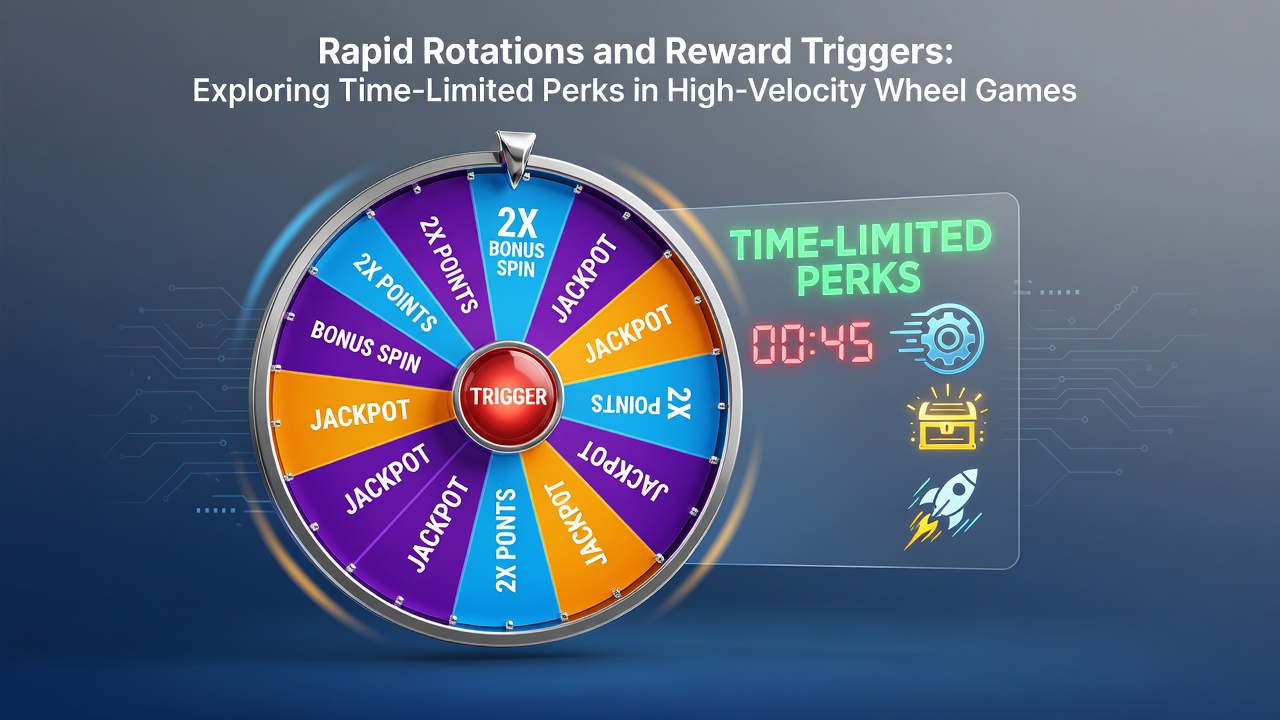
Telemetry collected across multiple sites reveals that time-limited perks generate distinct engagement spikes immediately after activation, followed by a tapering curve as the deadline approaches. Designers respond by inserting secondary micro-triggers, such as partial progress bars that refill on consecutive spins, to sustain momentum through the final minutes. Observers note that these layered indicators appear most often on mobile clients where screen real estate allows persistent overlay without obstructing the wheel animation.
Industry reports from the European Gaming and Betting Association highlight that operators refine timer lengths through A/B testing cycles conducted weekly, with adjustments calibrated against spin-velocity metrics rather than total revenue alone. When a ten-minute window produced higher per-minute bet volume than a thirty-minute window, the shorter duration became the default for subsequent campaigns. The same reports show that reward frequency, rather than reward size, correlates more strongly with session extension in high-velocity environments.
Technical Integration and Compliance Considerations
Backend systems must reconcile rapid spin logging with real-time reward state management, which requires low-latency databases capable of updating thousands of concurrent timers without drift. Regulators in several jurisdictions mandate that expiration logic remain transparent and auditable, so operators publish the precise rules governing each window in the game help files. These disclosures include the exact criteria for activation, the formula for multiplier calculation, and the method by which any unclaimed portion of a perk is forfeited at timer end.
Third-party testing laboratories verify that the random number generator continues to function independently of the reward timer, ensuring that time pressure does not alter outcome probabilities. Compliance documentation from Singapore’s Gambling Regulatory Authority, for example, requires explicit confirmation that timer events sit outside the RNG pipeline and cannot influence ball landing positions.
Conclusion
Time-limited perks embedded in high-velocity wheel games represent a convergence of accelerated mechanics and countdown-driven incentives that reshape session pacing across multiple regulatory landscapes. Data gathered through 2026 demonstrates consistent patterns of compressed decision windows and tiered engagement curves, while technical safeguards maintain separation between reward logic and outcome generation. Continued monitoring by academic and industry bodies will track how these structures evolve alongside further refinements in wheel speed and interface design.